Showing posts with label Shii. Show all posts

Tuesday, January 5, 2016

Who are right? Sunni or Shia (Shiite)

Is there a Quranic reason to prove that Shiite (Shia) is the true sect of Islam or Sunni?

Of-course! there are several verses in Quran which can be used to prove Shia are right or Sunnah (Sunni).
The main difference between Shia and Sunni is the subject of Imamat; Shia says Imam is chosen by Allah and He must say to his prophet who is the Imam after him. They say that the prophet Muhammad assigned Ali (as) as his Imam. On the other hand Sunni brothers say that Imam must be chosen by a council and Abubakr is the Imam after the prophet. Here I prove that Imam must be chosen by Allah not a council.
Shiite or Sunni? Proof of Imamat in Quran - Shia Truth
Who must choose Imam (Caliphs) of the prophet Muhammad (sawa)?

Imamat in Quran

Quran says :
.
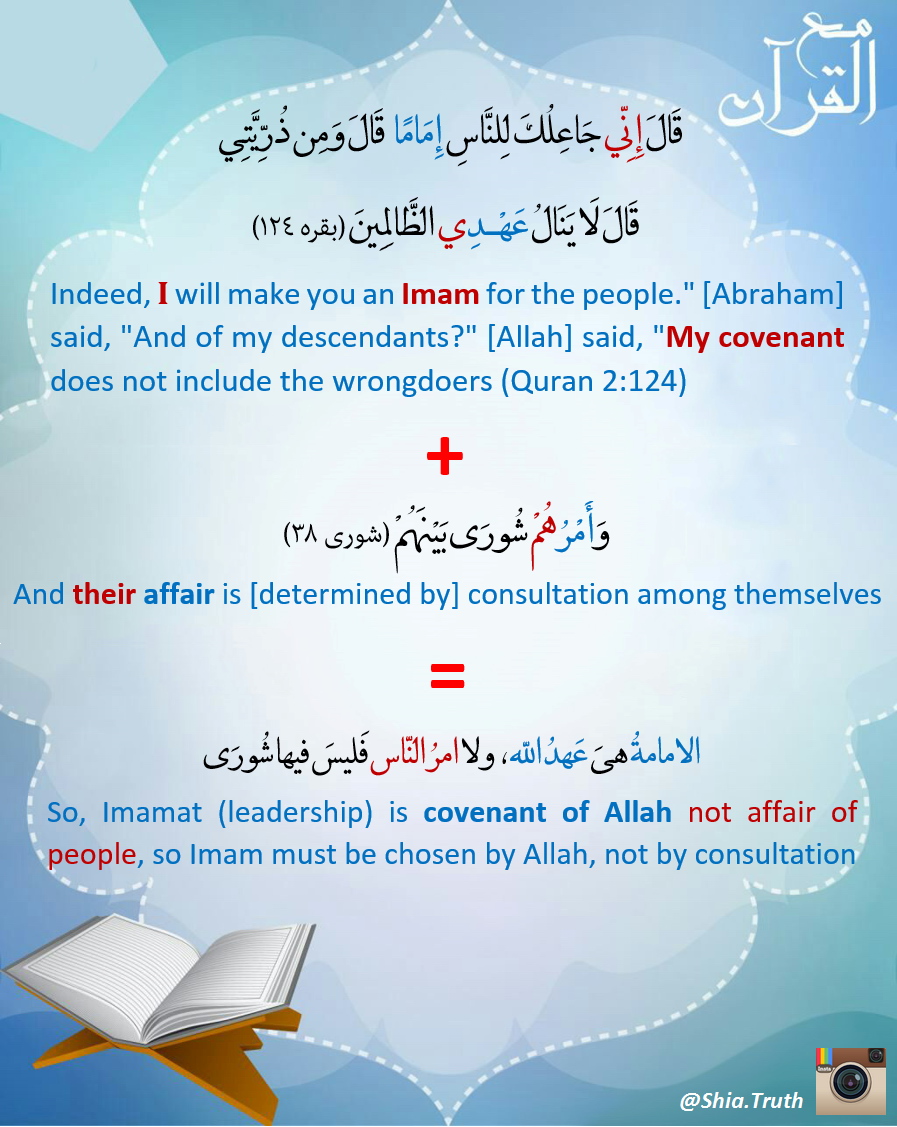
Indeed, I will make you an Imam for the people." [Abraham] said, "And of my descendants?" [Allah] said, "My covenant does not include the wrongdoers (Quran 2:124)
.
In another place, in Shora chapter, Quran says:
And their affair is [determined by] consultation among themselves (Quran 42:38)
.
Sunni Muslims use this last verse and claim that Imamat is an affair of Muslims and they must select an Imam by consultation. However the first verse says that Imamat is not an affair of people, its an affair and covenant of Allah and He must assign the Imam.

So, Imamat (leadership) is covenant of Allah not affair of people, and Imam must be chosen by Allah, not by consultation .

More images about Shia Islam: Shia Truth
.
قَالَ إِنِّي جَاعِلُكَ لِلنَّاسِ إِمَامًا قَالَ وَمِن ذُرِّيَّتِي قَالَ لَا يَنَالُ عَهْـــدِي الظَّالِمِينَ (بقره 124) ➕
وَأَمْرُهُمْ شُورَى بَيْنَهُمْ (شوری 38) ✅
الامامةُ هیَ عَهدُ اللّه، ولا امرُ النّاس فَلیسَ فیها شُورَى
في النهاية: ابابکر و عثمان جعلا امام الناس بالشوری و عمر جعل بأمر ابي بکر! ... فلا تقولوا حسبنا کتاب الله ايها المسلمون 

Sunday, October 25, 2015

Lessons from Imam Hussein and Ashura

Shia Truth - Lessons from Imam Hussein and Ashura
Some lessons from Imam Hussein and Ashura 

What is Ashura and Who is Imam Hussein?

Ashura is the tenth day of Muharram (the first month of the Islamic calendar). On this day, in more than 14 centuries ago and in a place called Karbala which is now in Iraq, Imam Hussain who was the 3'rd Imam of Shia Muslims and the grandson of the Prophet Muhammad (PBUH) along with many of his family members and all of his companions sacrificed their lives in order to save the teachings of Islam from utter distortion and destruction. Shia Muslims do not fast on this day. They dress in black and take to the streets and mosques on this day to commemorate the martyrdom anniversary of Prophet Muhammad’s grandson, Imam Hussein (PBUH) who is remembered as the symbol of freedom and dignity. Imam rose up against the tyrant of the time, Yazid, and was martyred after rejecting allegiance to him.
In the battle of Karbala, Imam Hussein and his companions were encircled by an army of 30,000 which decapitated martyrs and ran over bodies with horses.
Yazid’s army then plundered tents of Imam Hussein’s family and burned them. Then, they moved girls and women along heads of the martyrs to Yazid’s court.

See Who is Hussein for more details .

Wednesday, July 15, 2015

Shia or Sunni - Simple Proof

Which religion is right - Shia or Sunni?

There are a lot of books to answer this question, among them are Alghadir, Almurajiat and Nights of Peshawar. However there are several simple proofs for Shia which every Muslim without prejudice will accept them.
Shia - the true sect of Islam - shia or sunni?


Five simple questions from Sunni brothers 


There is a common narration from Sunni and Shia sources that says: everyone who dies and he does not know the Imam of his time, dies the death of ignorance. 
Question #1: Did Fatima (SA), know Imam of his time or not? If she did not, she is died in ignorance, NauzoBillah, and if she did, her Imam was Ali (as) not Abubakr. So Fatima was Shia

Sunni brothers say that the leader must be chosen by a council and shia say that the prophet appointed and mentioned all 12 Imams.
Question #2: Which council appointed the second caliph? Second caliph was appointed by Abubakr not a council! while Aboobakr was appointed by council of 13 people

There is a reliable Hadith from Shia and Sunni sources that says: Caliphs after the prophet (pbuh) are 12 (Twelve successors Hadith). 
Question #3: What are your 12 Imams? Count them and you can not find twelve Imams in Sunni Muslims while shia have exactly twelve Imams

Sunni Muslims, take their religion from four Imams: Imam Malik, Imam Shafi’i, Abu-Hanifeh and Ahmad-ibn-Hanbal. 
Question #4: These four imams you have, lived in what century? And what is their relation with the Caliphs? The Shia Imams are their Caliphs as well. But you have four caliphs and four imams who lived almost 100 years after Khulafa.

Shia Muslims have thousands of prayers and Monajats from their twelve Imams available in several books like Mafatih Aljanan, Sahife Sajjadiey, Almoraqibat, etc. 
Question #5: How many prayers, hymns or praise of the Lord you have quoted from your first three Caliphs or your 4 Imams? Count them and you will find nothing countable.

Now decide, Shia are wrong or Sunni? Unfortunately some extremist Muslims like ISIS say that shia are Kafir! and killing them has the reward of paradise! while grand Sunni scholars like Sheikh Shaltoot have confirmed Shiite as a true Islamic religion.

Thursday, July 2, 2015

Why do Muslims Fast

All Muslims, Shia and Sunni, fast during the month of Ramadan (Ramazan), i.e. they eat something, called Sahari, before Azan of morning prayer (about 1:30 hour to sunshine) and then don't eat anything during daylight hours until Azan Maghrib (about 15 minutes after sunset). They also must not drink, have intimate relations, swim, etc. After Azan Maghrib, they break their fast (Iftar).
Now, the question is Why do Muslims Fast during Ramadan?
Simple answer is that it is Wajib(obligatory) in Islam for healthy adults according to Quran(2:183):
O you who have believed, decreed upon you is fasting as it was decreed upon those before you that you may become righteous -
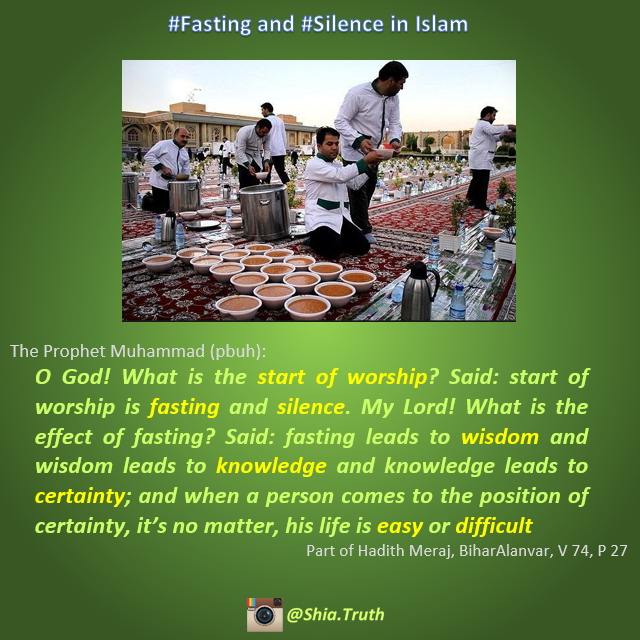
However, it has several advantages which some of them are described in Hadith of Miraj in where the prophet Muhammad(pbuh) ascended to the heaven and talked with Allah:
The Prophet Muhammad (pbuh) asked Allah: O God! What is the start of worship? He said: start of worship is fasting and silence. My Lord! What is the effect of fasting? Said: fasting leads to wisdom and wisdom leads to knowledge and knowledge leads to certainty; and when a person comes to the position of certainty, it’s no matter, his life is easy or difficult
Part of Hadith Meraj, BiharAlanvar, V 74, P 27
@Shia.Truth: Fasting in Islam - Shia-Muslem.blog.ir

Arabic and Farsi translations

Thursday, November 20, 2014

Shia primary and Secondary Principles

As I said in the Previous article, Three steps to become a shiite, there are two types of beliefs in theology of Shia Islam: primary and secondary principles. Primary principles like oneness of Allah and prophecy of Muhammd must be achieved with research while, in secondary principles like Salat and Fasting we must follow a religious expert (a Mujtahid) like Ayatollah Khamenei or Ayatollah Sistani or others.

The following picture shows primary (Osule Din) and secondary beliefs (Foru'e Din) of Shia Muslims.


Wednesday, November 12, 2014

Shia Beliefs

Twelver Shia Muslims have five principles:
  1. Tawhid (توحید): Allah is the only God in the world.
    He is not born of anyone nor gave birth to any one, nor is any one like Him
  2. Prophethood (نبوت): Muhammad (PBUH) is the last prophet of Allah.
    Shia Muslims believe in all the Prophets that God has appointed to guide mankind.
  3. Imamat (امامت): After the prophet, there are 12 Imams,
    responsible for guidance and leadership of Muslims. They are appointed by Allah.
  4. Fairness: Allah is Fair, he doesn’t oppress anyone
    God does not punish people who have obeyed and worshipped him, and does not reward people who have disobeyed Him
  5. Resurrection: All mankind will be resurrected on the Day of Judgment
    To be judged for their actions and rewarded or punished, depending on each individual’s worldly conduct
Read more about the principles of Shia

Shia (Shiite) Muslims Beliefs (Five Principles: Tawhid-Prophethood-Imamat-Justice-Resurrection)